Dissociation Between Convergence Insufficiency Symptom Survey Scores and Objective Binocular Vision Function in First- and Second-Year Optometry Students
Purpose. To compare objective binocular vision function, self-reported visual symptom burden, and weekly digital device usage between first- and second-year Doctor of Optometry (OD) students, and to identify factors independently associated with elevated symptom scores.
Material and Methods. This cross-sectional study enrolled 30 first-year (OD1) and 30 second-year (OD2) OD candidates at the Western University of Health Sciences College of Optometry. Data collection used a subset of clinical measures associated with the Convergence Insufficiency Treatment Trial (CITT) and included near point of convergence (NPC) break and recovery, distance and near heterophoria, Randot stereoacuity, and the Convergence Insufficiency Symptom Survey (CISS). Positive fusional vergence (PFV) at near, one of the cardinal CITT diagnostic criteria, was not assessed. Weekly digital device usage was self-reported. Because most continuous variables were non-normally distributed, between-group comparisons were performed using Mann–Whitney U tests, with the exception of CISS score, which was normally distributed and compared using an independent samples t-test. Associations among variables were examined using Spearman correlation. Predictors of CISS score were assessed by multiple linear regression, controlling for age, year of study, total device hours, NPC break, and distance phoria.
Results. Second-year students reported significantly higher CISS scores than first-year students (17.93 ± 8.91 vs. 12.93 ± 7.52; p = 0.022). All objective binocular vision measures – NPC break, NPC recovery, distance and near phoria, and Randot stereoacuity – did not differ significantly between cohorts. Weekly digital device usage was comparable between groups (p = 0.222). CISS score correlated significantly only with distance phoria (rs = 0.305; p = 0.018). No significant correlation was observed with NPC, stereoacuity, or device usage. In multivariable regression, no variable reached statistical significance in the full model. Three of 60 participants (5.0 %) met the CITT-associated criteria assessable in this study. Because PFV was not measured, these participants are characterized as exhibiting clinical features consistent with convergence insufficiency (CI) rather than as having a confirmed CITT diagnosis, and no determination of true CI prevalence is possible.
Conclusion. Elevated visual symptom burden in second-year OD students was not accompanied by measurable deterioration in objective binocular vision function, and was not explained by digital device usage. The modest correlation between CISS score and distance phoria suggests that individuals with higher baseline exophoria at distance may carry less fusional reserve and be more susceptible to visually induced symptoms under sustained academic load. These findings suggest the possibility that factors other than binocular dysfunction may contribute to elevated CISS scores in graduate student populations under academic stress, and underscore the need for longitudinal studies incorporating stress, sleep, and burnout as covariates.
Introduction
Graduate health professions education imposes substantial and sustained near vision demands onstudents. Reading, laboratory work, clinical training, and digitally mediated learning all require prolonged periods of convergence and accommodation, placing the visual system under conditions that may exceed those encountered in other occupational or academic settings. For Doctor of Optometry (OD) candidates, these demands are compounded by clinical training requirements that additionally demand fine stereoscopic skills for techniques such as slit-lamp biomicroscopy and binocular indirect ophthalmoscopy, in which the practitioner’s own binocular vision is an instrument of examination.1 The potential consequences of undetected or unmanaged binocular vision disorders in this population therefore extend beyond academic performance to professional competency.
Convergence insufficiency (CI) is among the most prevalent binocular vision disorders encountered in clinical practice, characterized by difficulty maintaining comfortable binocular single vision at near.2 Diagnosis is standardized by the criteria of the Convergence Insufficiency Treatment Trial (CITT), which require the concurrent presence of exophoria at near at least 4∆ greater than at distance, a receded near point of convergence (NPC) with break ≥ 6 cm, reduced positive fusional vergence (PFV) at near (failing Sheard’s criterion or PFV break ≤ 15∆ base-out at near), and an elevated Convergence Insufficiency Symptom Survey (CISS) score, in the context of intact best-corrected visual acuity and stereopsis.3 Symptoms associated with CI, including asthenopia, diplopia, blurred near vision, headache, and reading-related difficulties, overlap substantially with those of other conditions, which may contribute to underdiagnosis in academic populations.4
The past decade has seen a dramatic expansion of digital device use in higher education, a trend substantially accelerated by the COVID-19 pandemic.5 Graduate students now rely on laptops, tablets, and smartphones for a large proportion of academic tasks, including lectures, assessments, and independent study.6 This shift introduces sustained near-point visual demands of a qualitatively different character from traditional print-based study. Digital screen-based tasks have been associated with reduced blink rates, increased accommodative demand variability, and a constellation of symptoms collectively termed digital eye strain, including ocular dryness, asthenopia, and headache.7 Several of these symptoms overlap directly with the symptom profile of CI, raising the question of whether intensive digital device use may exacerbate or unmask convergence dysfunction in susceptible individuals, or whether elevated symptom scores in high-use populations reflect digital eye strain rather than true binocular vision disorder.16
Despite the intuitive plausibility of a link between prolonged digital near work and CI, the empirical literature on this relationship remains sparse, particularly in graduate student populations.5 The optometry student population represents a uniquely informative cohort for this investigation since digital device usage is high and relatively homogeneous, near vision demands escalate predictably across academic years, and the progression from first to second year at many colleges of optometry involves a substantive increase in academic load, including preparation for the National Board of Examiners in Optometry (NBEO) Applied Basic Science examination.
The purpose of the present study was to compare objective binocular vision function, self-reported visual symptom burden, and weekly digital device usage between first- and second-year OD students at a single institution, and to examine associations among these measures. We hypothesized that second-year students would demonstrate greater symptom burden and more compromised objective binocular vision metrics compared to first-year students, consistent with the cumulative near vision demands of advancing graduate study.
Material and Methods
Study Design and Setting
This was a cross-sectional, single-institution observational study conducted at the Western University of Health Sciences (WesternU) College of Optometry in Pomona, California. The study received institutional review board approval, and all participants provided informed consent prior to enrollment. Data were collected and managed in compliance with the Health Insurance Portability and Accountability Act (HIPAA).
Participants
Thirty first-year (OD1) and 30 second-year (OD2) candidates for the Doctor of Optometry degree were recruited from the WesternU College of Optometry. To control for the effects of diurnal variation in visual performance and fatigue, all data collection sessions were conducted between 12:00 pm and 5:00 pm in a well-lit examination room. Demographic information, including age, sex, and self-reported ethnicity following U.S. Census Bureau guidelines, was collected by anonymous survey.
Exclusion criteria included previous diagnosis or treatment of convergence insufficiency, preexisting systemic or ocular conditions with symptom profiles overlapping those of CI or digital eye strain, and medications known to affect accommodation or vergence. Masking of investigator and participants was not feasible given the collaborative structure of the optometry curriculum and shared extracurricular activities across cohorts.
Clinical Data Collection
Clinical measures were obtained by one investigator using a subset of the testing procedures specified by the 2018 Convergence Insufficiency Treatment Trial.3 Positive fusional vergence at near, one of the four cardinal CITT diagnostic criteria, was not assessed; the implications of this omission for diagnostic classification are addressed below (Section Diagnostic Criteria Applied in This Study) and in the Limitations. The following data were collected for each participant:
1. Convergence Insufficiency Symptom Survey (CISS): A validated 15-item self-report instrument quantifying the frequency of visual symptoms associated with near work. Each item is rated on a 5-point scale (0 = never to 4 = always), yielding a total score from 0 to 60. A cutoff of ≥ 16 was originally established as clinically significant in children aged 9 to 18 years,8 whereas subsequent validation in adults aged 19 to 30 years yielded a higher threshold of ≥ 21.9 Because all participants in this study were at least 22 years of age at the time of data collection, the adult threshold of ≥ 21 was applied. The pediatric threshold of ≥ 16, established for children aged 9 to 18 years,8 is not applicable to this sample. The complete CISS instrument is reproduced in the Appendix.
2. Near Point of Convergence (NPC): Break and recovery distances were measured in centimeters from the spectacle plane using an accommodative target advanced along the midline toward the patient’s face. An NPC break ≥ 6 cm was considered receded per CITT criteria.
3. Best-Corrected Visual Acuity (BCVA): Monocular and binocular BCVA were measured at distance and near using an ETDRS chart. BCVA ≥ 20/25 in each eye at both distances was required per CITT criteria.
4. Heterophoria: Distance (6 m) and near (40 cm) phoria were quantified using the cover-uncover and alternating cover test with prism bars. Exophoria was recorded as positive values (base-in); esophoria as negative values (base-out), expressed in prism diopters (∆). That is, a positive numerical value indicates an exophoric deviation compensated with base-in prism; a negative value indicates an esophoric deviation compensated with base-out prism; and zero indicates orthophoria.
5. Randot Stereoacuity: Stereoscopic depth perception was assessed using the Randot stereotest (Stereo Optical Co., Chicago, IL) in arc seconds. All participants were required to appreciate stereopsis at the 500 arc sec target level per CITT criteria.
6. Digital Device Usage: Participants self-reported average weekly screen time in hours, separately for academic purposes (coursework, online learning, studying) and non-academic purposes (social media, entertainment), with total hours computed as their sum. Smartphones, tablets, and computers were included in both categories; passive background screen time was not counted. Academic use was defined as device time for reading, practice problems, digital flash cards, lectures, and studying. Non-academic use was defined as leisure, communication unrelated to school, watching videos, or social media, excluding television viewed at a distance.
Diagnostic Criteria Applied in This Study
The full CITT diagnostic criteria for convergence insufficiency comprise: (i) exophoria at near at least 4∆ greater than at distance; (ii) NPC break ≥ 6 cm; (iii) reduced positive fusional vergence at near (failing Sheard’s criterion or PFV break ≤ 15∆ base-out at near); and (iv) symptomatic CISS score (≥ 21 in adults; ≥ 16 in children aged 9–18 years), in participants with BCVA ≥ 20/25 in each eye at distance and near and appreciation of Randot stereopsis at the ≤ 500 arc sec target.3,8,9
Because positive fusional vergence at near was not measured in the present study, the full CITT diagnostic combination could not be evaluated. Participants were instead identified as exhibiting clinical features consistent with CI when all of the following CITT-associated criteria, assessable from the available data, were simultaneously satisfied:
1. BCVA ≥ 20/25 in each eye at distance and near
2. Exophoria at near at least 4∆ greater than at distance
3. NPC break ≥ 6 cm
4. Appreciation of Randot stereopsis at the ≤ 500 arc sec target
5. CISS score ≥ 21 (adult threshold)
Participants meeting all five available criteria are referred to throughout this manuscript as exhibiting clinical features consistent with CI rather than as having a confirmed CITT diagnosis.
Statistical Analysis
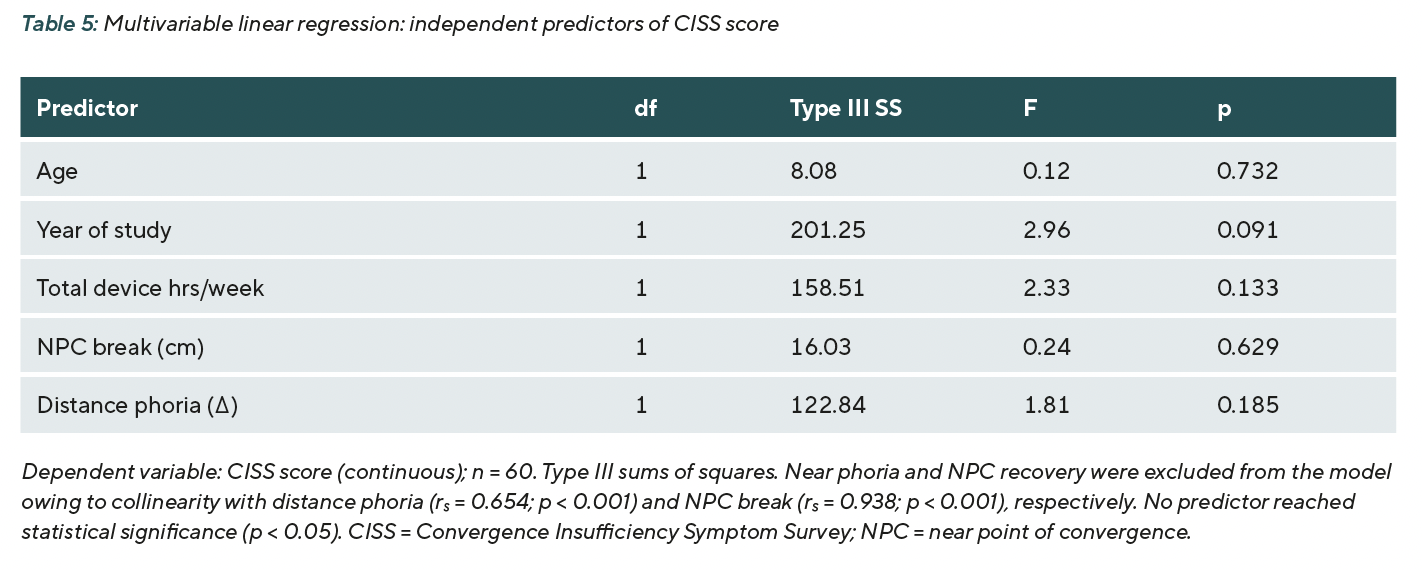
Normality of all continuous variables was assessed within each cohort using the Shapiro-Wilk test. Normally distributed variables are presented as mean ± standard deviation (SD) and non-normally distributed variables are presented as median with first and third quartiles [Q1, Q3]. Between-group comparisons for continuous variables were performed using independent samples t-tests for normally distributed variables and Mann-Whitney U tests for non-normally distributed variables. Proportions of participants meeting individual CITT diagnostic criteria were compared between cohorts using Fisher’s exact test. Associations among continuous variables were examined using Spearman rank correlation coefficients (rs), with a threshold of |rs| ≥ 0.30 identified a priori as potentially meaningful given the sample size. Because these analyses were exploratory in nature, unadjusted p-values are reported, and interpretation emphasizes the magnitude and direction of association rather than formal hypothesis testing. Year of study was significantly associated with CISS score in a model without distance phoria and remained significant after adjustment for age, total digital device use, and NPC break. However, after further adjustment for distance phoria in the full multivariable model, this association was attenuated and no longer statistically significant, suggesting that the year-related difference in CISS score shares variance with clinical visual function measures included in the model. Multivariable linear regression was performed with CISS score as the dependent variable and year of study, age, total weekly device hours, NPC break, and distance phoria as independent variables. Near phoria and NPC recovery were excluded from the model owing to their strong collinearity with distance phoria (rs = 0.654; p < 0.001) and NPC break (rs = 0.938; p < 0.001), respectively; their inclusion would have inflated standard errors without adding independent information. Type III sums of squares were used to assess the independent contribution of each predictor. All analyses were conducted in SAS (SAS Institute Inc., Cary, NC). Statistical significance was defined as p < 0.05 (two-tailed). A formal a priori power calculation was not performed. Sensitivity analysis indicated that with 30 participants per group, α = 0.05 (two-tailed), and 80 % power, the minimum detectable standardized mean difference for the primary between-group comparison was d = 0.74.
Results
Participant Demographics
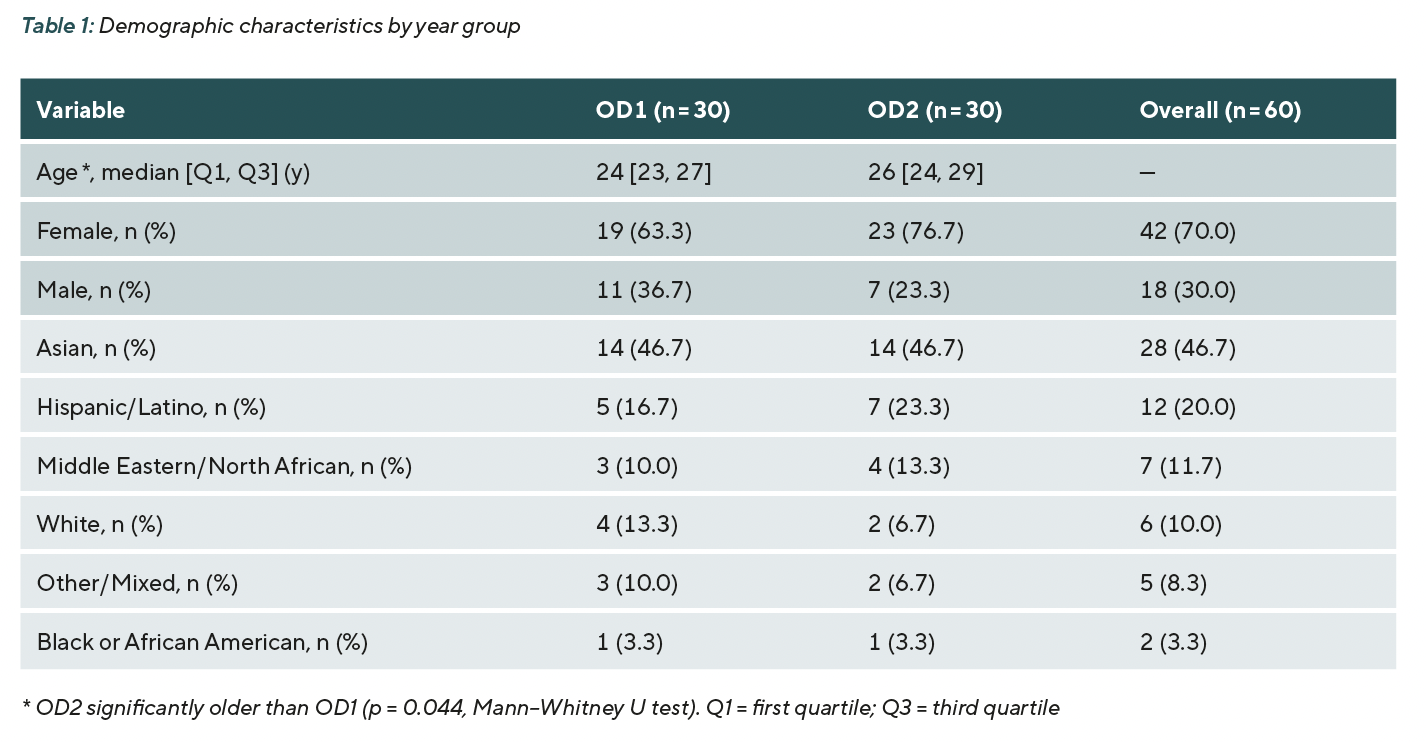
Sixty OD students were enrolled: 30 OD1 (19 female, 11 male) and 30 OD2 (23 female, 7 male). The ethnic distribution across the full sample included 46.7 % (n = 28) Asian, 20.0 % (n = 12) Hispanic/Latino, 11.7 % (n = 7) Middle Eastern/North African, 10.0 % (n = 6) Caucasian, 8.3 % (n = 5) Other/Mixed, and 3.3 % (n = 2) African American (Table 1). As expected from the sequential year-group design, OD2 students were significantly older than OD1 students (median age 26 [24, 29] vs. 24 [23, 27] years; p = 0.044), a difference of approximately two years. Age was included as a covariate in all regression analyses.
Between-Group Comparisons of Clinical Measures
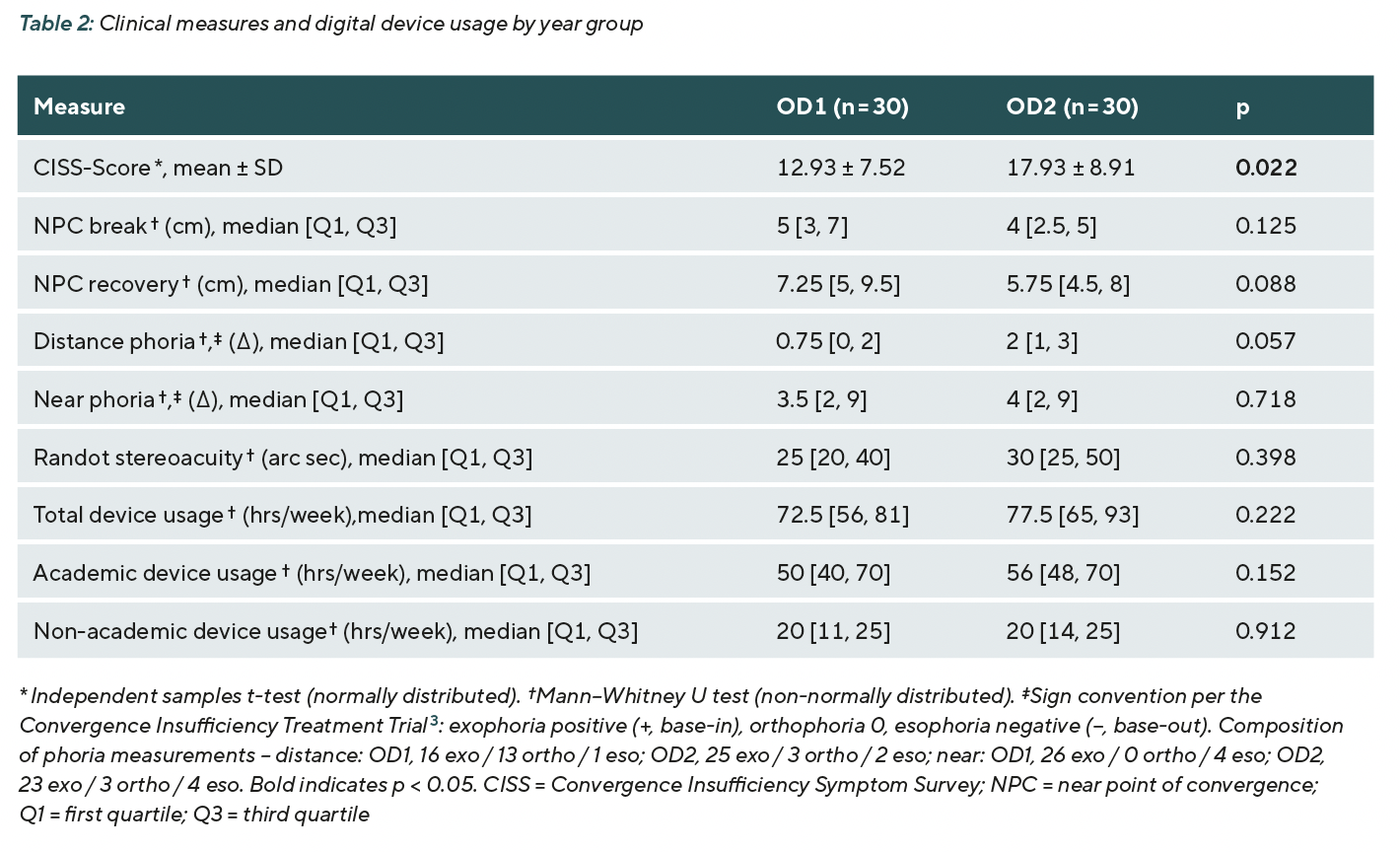
Group-level descriptive statistics and between-group comparisons for all clinical and device-usage measures are presented in Table 2. CISS score was the only variable that was normally distributed in both cohorts. All other continuous variables were non-normally distributed and are reported as medians with interquartile ranges.
CISS score was significantly higher in OD2 students compared to OD1 students (17.93 ± 8.91 vs. 12.93 ± 7.52; p = 0.022; Cohen’s d = 0.61), indicating a greater burden of self-reported visual symptoms in the second-year cohort. No significant between-group differences were observed for any objective binocular vision measure: NPC break (p = 0.125), NPC recovery (p = 0.088), distance phoria (p = 0.057), near phoria (p = 0.718), or Randot stereoacuity (p = 0.398). Weekly digital device usage also did not differ significantly between cohorts (p = 0.222). The modest numerical difference in total device usage between cohorts was driven almost entirely by academic hours (median 50 vs. 56), while non-academic hours were essentially identical (median 20 in both groups); neither component differed significantly between cohorts.
Available CITT-Associated Criteria and Findings Consistent with CI
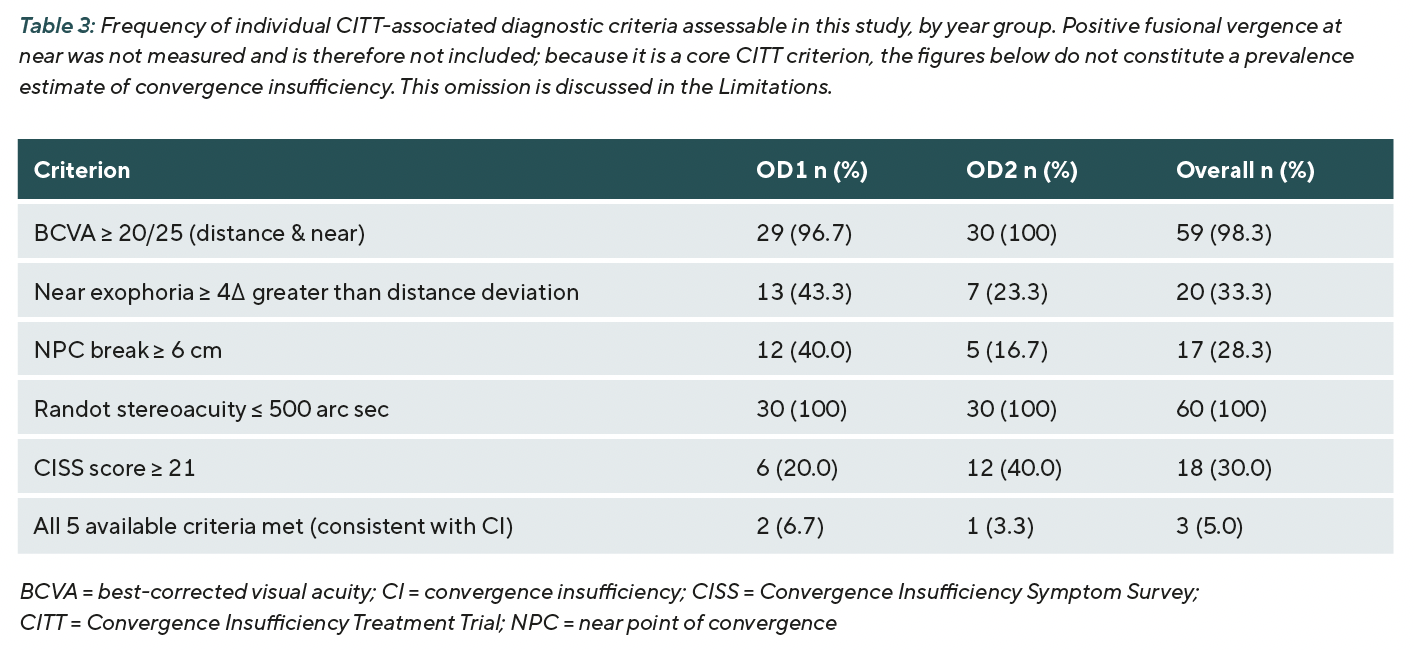
The frequency of each individual CITT-associated diagnostic criterion assessable in this study, by cohort, is presented in Table 3. All 60 participants (100 %) met the stereoacuity criterion (≤ 500 arc sec). The BCVA criterion (≥ 20/25 distance and near) was met by 29 OD1 students (96.7 %) and all 30 OD2 students (100 %). The proportion of participants with a receded NPC break (≥ 6 cm) was higher in OD1 than OD2 (40.0 % (n = 12) vs. 16.7 % (n = 5)). Applying the adult CISS threshold, a score ≥ 21 was reported by 6 OD1 students (20.0 %) and 12 OD2 students (40.0 %). Near exophoria at least 4∆ greater than distance was present in 13 OD1 students (43.3 %) and 7 OD2 students (23.3 %), with an overall frequency of 20 of 60 participants (33.3 %).
Two OD1 students (6.7 %) and one OD2 student (3.3 %), three of 60 participants (5.0 %) overall, simultaneously satisfied all five CITT-associated criteria assessable in this study. Because positive fusional vergence at near was not measured, these participants are characterized as exhibiting clinical features consistent with CI rather than as meeting a strict CITT diagnostic standard. A substantial proportion of them could have normal PFV and therefore would not qualify for a CI diagnosis under the full CITT criteria; accordingly, the 5.0 % figure should not be interpreted as a prevalence estimate of convergence insufficiency. Their number was in any case insufficient to support inferential comparison between cohorts or correlation analyses involving CI status as a binary outcome.
Correlation Analyses
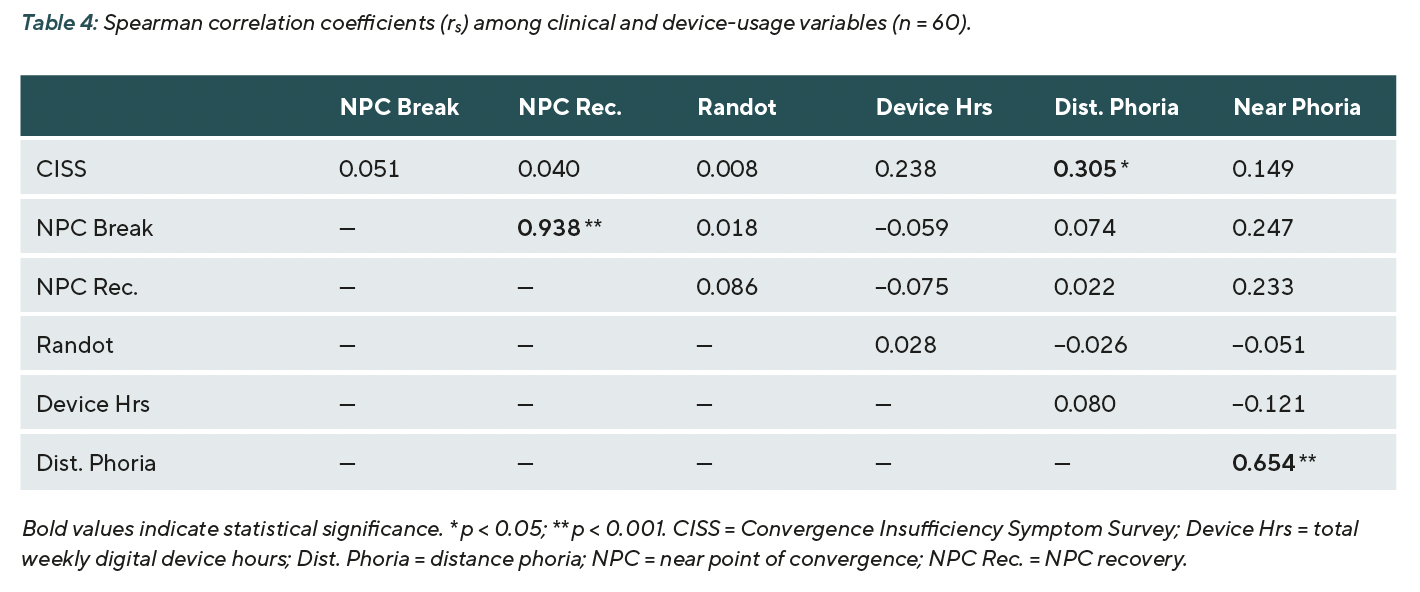
Spearman correlation coefficients among all continuous variables are presented in Table 4. Of the associations between CISS score and the binocular vision measures, only distance phoria reached statistical significance: rs = 0.305 (p = 0.018), indicating a moderate positive association between more positive (more exophoric) phoria at distance and higher symptom burden. No significant correlations were observed between CISS score and NPC break (rs = 0.051; p = 0.699), NPC recovery (rs = 0.040; p = 0.762), Randot stereoacuity (rs = 0.008; p = 0.953), or near phoria (rs = 0.149; p = 0.255). Total weekly device usage showed a non-significant positive trend with CISS score (rs = 0.238; p = 0.068). Because these correlation analyses were exploratory rather than confirmatory, no correction for multiple comparisons was applied. The single statistically significant association (rs = 0.305; p = 0.018) should therefore be interpreted with appropriate caution and replicated in future work.
Two expected strong correlations were observed within the objective binocular vision data: NPC break and NPC recovery were highly correlated (rs = 0.938; p < 0.001), as were distance and near phoria (rs = 0.654; p < 0.001). These reflect the physiological interdependence of the paired measures and are not interpreted as independent findings.
Multivariable Regression: Predictors of CISS Score
Results of the multivariable linear regression analysis with CISS score as the dependent variable are presented in Table 5. None of the predictors reached statistical significance in the full multivariable model. Age (F1,54 = 0.12; p = 0.732), year of study (F1,54 = 2.96; p = 0.091), total device hours (F1,54 = 2.33; p = 0.133), NPC break (F1,54 = 0.24; p = 0.629), and distance phoria (F1,54 = 1.81; p = 0.185) did not contribute independently to the prediction of symptom burden. NPC recovery was excluded from the model owing to its strong positive correlation with NPC break (rs = 0.938; p < 0.001), and near phoria was excluded owing to its moderate positive correlation with distance phoria (rs = 0.654; p < 0.001); inclusion of these collinear pairs would have inflated standard errors without adding independent information.
Discussion
Summary of Principal Findings
This cross-sectional study examined the relationship between self-reported visual symptom burden, objective binocular vision function, and digital device usage in first- and second-year OD students. Three principal findings emerged. First, second-year students reported significantly higher CISS scores than first-year students in the absence of any significant difference in objective binocular vision measures between cohorts. Second, CISS scores correlated significantly only with distance phoria among all clinical and device-usage variables examined (rs = 0.305). Third, in multivariable regression, no predictor reached statistical significance in the full model, including year of study, distance phoria, total weekly digital device hours, NPC break, and age. These findings suggest that the elevated symptom burden observed in second-year students reflects factors that are not fully separable from clinical visual function measures in the present sample.
Dissociation Between Symptom Burden and Objective Binocular Vision Function
CISS scores differed significantly between cohorts, whereas objective binocular vision measures did not. This dissociation merits careful interpretation. A straightforward reading might suggest that second-year students are developing convergence dysfunction that the clinical measures are insufficiently sensitive to detect. However, this interpretation is difficult to sustain given the breadth of the objective battery used. NPC break and recovery, distance and near phoria, and Randot stereoacuity together constitute the full complement of CITT-specified measures 3 assessed in this study and none reached statistical significance; distance phoria (p = 0.057) and NPC recovery (p = 0.088) showed numerical trends that did not survive the α = 0.05 threshold. If the CISS were tracking convergence dysfunction specifically, NPC break would be expected to emerge as a significant predictor in the regression model, since it is the most direct objective correlate of convergence ability. Its failure to do so, alongside the failure of distance phoria and all other predictors to reach significance in the full multivariable model, supports the view that elevated symptom scores in this population reflect factors beyond the state of the vergence system. A simpler interpretation is that the CISS, in this population and context, is capturing a broader symptom cluster not specific to convergence insufficiency.
The CISS was developed and validated in a sample of children aged 9 to 18 years with clinically confirmed CI.8 Its 15 items, which include eyestrain, headache, blurred near vision, diplopia, and difficulty reading or concentrating, overlap substantially with the symptom profiles of general asthenopia, digital eye strain, and visually induced fatigue.7 In a population of graduate students without a clinical diagnosis of CI and under conditions of elevated academic stress, these symptoms are unlikely to arise exclusively or even primarily from convergence dysfunction. The CISS may therefore lack sufficient specificity to discriminate between symptomatic CI and general visual fatigue in non-clinical populations, though this interpretation is speculative in the absence of direct measures of stress, burnout, or sleep quality in the present study, and has not been extensively studied in adult graduate or professional student cohorts.
It is also noteworthy that the OD2 cohort’s mean CISS score of 17.93 falls below the adult clinical threshold for symptomatic CI (≥ 21),9 and 60 % of OD2 students score below this threshold individually. The elevation in symptom burden observed in second-year students therefore does not reflect a wholesale crossing into the symptomatic CI range, but rather a rightward shift in the continuous distribution of scores. This pattern is more consistent with a generalized increase in visual symptom burden under academic load than with the emergence of clinically actionable convergence dysfunction in this cohort.
The Association Between CISS Score and Distance Phoria
The moderate and statistically significant correlation between CISS score and distance phoria (rs = 0.305; p = 0.018) warrants specific discussion, particularly because the analogous correlation with near phoria was non-significant (rs = 0.149; p = 0.255). This asymmetry is counterintuitive from a CI-centric perspective, since near exophoria is the defining vergence feature of CI. It should be noted that rs = 0.305 corresponds to approximately 9 % of explained variance (R2 ≈ 0.09), indicating that the association, while statistically significant, is modest in magnitude and should be interpreted cautiously.
Two speculative explanations may be considered for this pattern. First, higher exophoria at distance may serve as a proxy for overall vergence system instability, though this cannot be confirmed here as positive fusional vergence was not measured. If so, individuals with a greater baseline exophoric posture at distance might be more susceptible to visual fatigue and symptomatic breakdown under any sustained visual load, a hypothesis that would require direct PFV measurement to test. Second, the strong correlation between distance and near phoria (rs = 0.654; p < 0.001) means that the two measures share substantial variance. The near phoria may carry a genuine but statistically weaker association with CISS that fails to reach significance at this sample size. Future studies with greater statistical power and inclusion of PFV measurement should examine these relationships in more detail.
It is also noteworthy that distance phoria in OD2 students showed a trend toward greater exophoric deviation compared to OD1 students (median 2.0 vs. 0.75 ∆ BI; p = 0.057). If confirmed in a larger sample, this would suggest a possible shift in vergence posture accompanying advancing academic year, though the clinical significance of this trend remains uncertain without PFV data.
Academic Year and Symptom Burden
The between-group difference in CISS score was statistically significant (12.93 ± 7.52 vs. 17.93 ± 8.91; p = 0.022), with second-year students reporting greater symptom burden than first-year students. In the multivariable model without distance phoria, year of study emerged as a significant independent predictor of CISS score. However, this association was attenuated and no longer statistically significant after distance phoria was included in the full model (F1,54 = 2.96; p = 0.091). Exploratory mediation analyses did not identify a significant indirect effect through any single tested mediator and the attenuation is therefore best characterized as shared variance among covariates rather than confirmed mediation.
Second-year OD students face a heavier academic burden than first-year students, including a more demanding didactic curriculum and early clinical rotations. These demands are associated with elevated levels of academic stress and burnout, which increase progressively with year of study in medical and health professions education.10 Academic stress and burnout have welldocumented relationships with sleep disruption,11 and poor sleep quality has in turn been associated with exacerbated asthenopia symptoms that overlap substantially with the CISS item pool.12 This mechanistic chain, advancing academic year → elevated stress → disrupted sleep → increased asthenopia → higher CISS scores, offers a coherent account of the between-group difference in symptom burden without requiring any underlying convergence dysfunction. When objective visual function measures were included as predictors in the full multivariable model, however, the independent contribution of academic year was no longer statistically significant, underscoring that the observed between-group difference in symptom burden cannot be attributed to academic year alone in the presence of shared clinical variance.
Notably, age did not contribute independently to the regression model despite the small but statistically significant age difference between cohorts (p = 0.044). This suggests that any symptom elevation is a function of the academic year experience itself rather than simply of being one year older.
Digital Device Usage and Symptom Burden
Contrary to the initial study hypothesis, neither total, academic, nor non-academic digital device usage differed significantly between cohorts, and total device hours did not independently predict CISS score in regression (p = 0.133). The non-significant trend between device usage and CISS (rs = 0.238; p = 0.068) suggests a possible weak positive association that the current sample was underpowered to confirm, consistent with observations from the COVID-19 pandemic period in which increased screen time was associated with elevated asthenopia and headache.5,13 The high overall level of device usage in this sample of approximately 77.6 hours per week, equivalent to roughly 11 hours per day, may reflect a ceiling effect, whereby uniformly high device exposure across all participants reduces its discriminative power as a predictor of between-person differences in symptom burden; however, a ceiling effect was not formally investigated in this study and this explanation should be regarded as hypothetical.
Frequency of Clinical Features Consistent with CI
Three of 60 participants (5.0 %) exhibited clinical features consistent with CI on the criteria assessable in this study; this figure is broadly consistent with population-based estimates of CI prevalence in young adults, which typically range from approximately 4 % to 8 %.2 Because positive fusional vergence at near was not measured, this figure is not directly comparable to studies applying the full CITT diagnostic combination, and should be regarded as an upper bound. The numerically higher proportion in first-year students (6.7 %) compared to second-year students (3.3 %) is of uncertain significance given the very small absolute numbers (2 vs. 1 participant). The more meaningful observation is that the number of cases was insufficient to support inferential analysis, underscoring the need for larger samples and inclusion of PFV testing in future work targeting CI diagnosis as a primary outcome.
Limitations
Several limitations should be considered. Positive fusional vergence at near, one of the four cardinal CITT diagnostic criteria, was not measured in this study. A strict CITT-based diagnosis of convergence insufficiency therefore could not be established, and the three participants meeting the available criteria are best characterized as exhibiting clinical features consistent with CI. This also constrains direct comparison of the present prevalence figure with studies applying the full CITT diagnostic combination. The sample was restricted to 60 students at a single institution, limiting statistical power and generalizability. Sensitivity analysis indicates that this sample size provided 80 % power to detect a standardized mean difference in CISS score, measured by Cohen’s d, of 0.74 in the between-group comparison. The observed effect (d = 0.61) falls modestly below this threshold, a limitation acknowledged in the interpretation of the CISS group difference. For the non-significant differences in objective binocular vision measures between groups, the betweengroup differences were small in absolute terms, which provides reasonable evidence against a large undetected effect. The one-year interval between cohorts is a narrow window for detecting cumulative effects. Comparisons spanning larger intervals, such as between first- and third- or fourth-year students, for whom clinical training adds substantial binocular vision demands 1, might yield more pronounced findings. Digital device usage was self-reported, introducing recall bias. To avoid this, future studies could incorporate objective screen-time logs. The study did not include measures of sleep quality, academic stress, or burnout. Given their proposed role in explaining elevated CISS scores, future work should incorporate validated instruments such as the Pittsburgh Sleep Quality Index 14 or the Maslach Burnout Inventory for Students.15 The cross-sectional design precludes causal inference, masking was not feasible, and although the CISS has been validated in both pediatric 8 and adult 9 populations, its psychometric properties in graduate or professional students under sustained academic stress have not been independently characterized.
Future Directions
A longitudinal design following OD students from year 1 through year 3 or 4 would allow examination of within-subject trajectories in both CISS scores and objective binocular vision measures, capturing the transition into clinical training where binocular vision demands qualitatively increase.1 Inclusion of positive fusional vergence at near would permit application of the full CITT diagnostic combination and direct comparability with the wider CI prevalence literature. Incorporating validated measures of sleep quality, stress, and burnout would allow a formal test of the mediation hypothesis. A multi-institution sample would improve generalizability and statistical power. Finally, the CISS–distance phoria relationship identified here should be replicated in larger samples and explored mechanistically.
Conclusions
Second-year Doctor of Optometry students reported significantly greater visual symptom burden compared to first-year students, as measured by the Convergence Insufficiency Symptom Survey, in the absence of any measurable difference in objective binocular vision measures between cohorts. In multivariable regression, no predictor – including year of study, distance phoria, total device hours, NPC break, or age – reached statistical significance in the full model. A moderate correlation between CISS score and distance phoria suggests that baseline vergence posture may modulate susceptibility to visually induced symptoms under academic load, but the absence of positive fusional vergence measurement precludes a definitive conclusion regarding the role of convergence insufficiency as a driver of elevated symptom scores. These findings suggest the possibility that factors other than binocular dysfunction – such as burnout, sleep disruption, and general asthenopia – may contribute substantially to symptom burden in this context, though direct measures of these factors were not obtained in the present study and this interpretation requires confirmation in future work. Longitudinal studies with larger, diverse samples, inclusion of positive fusional vergence testing, and concurrent assessment of sleep, stress, and objective binocular vision function are needed to fully characterize the visual health demands of optometric education.
Conflict of Interests
The authors declare that there is no conflict of interests regarding the methods and devices mentioned in the article.
Acknowledgements
The authors thank Dr. Mark Wu, OD, Western University of Health Sciences, for inspiring this study and for his valuable input during its early development.