Effects of Multimodal Eccentric Viewing Training on Reading Speed
Purpose. Bilateral loss of foveal visual function impairs reading-relevant visual, oculomotor and cognitive processes. Eccentric viewing training (EVT) represents an approach in low vision rehabilitation for improving reading function. The aim of this study was to investigate the efficacy of a multimodal EVT within the context of inpatient rehabilitation.
Material and Methods. In a randomized, controlled, exploratory trial, 17 participants of the Henneberg-Rehaklinik Masserberg with bilateral central scotoma completed an EVT intervention over a period of three weeks. A multimodal EVT (biofeedback training, computer-based EVT, Move-the-text training; intervention arm, n = 8) was compared with a monomodal EVT (biofeedback training, smooth pursuit training; control arm, n = 9). The primary endpoint was reading speed (IReST, SKread). Secondary endpoints included fixation stability (P1, P2, BCEA), reading acuity, reading error rate, distance visual acuity, contrast sensitivity, the NEI VFQ-25-C, and the evaluation of the training.
Results. Median IReST reading speed changed by +5.3 wpm (IQR 53.8 wpm) in the intervention arm and by +6.0 wpm (IQR 9.7 wpm) in the control arm, while SKread revealed only small pre–post changes (multimodal EVT: +0.3 Z/s; monomodal EVT: +0.1 Z/s). The median pre–post change in light difference sensitivity at the extrafoveal fixation locus was significantly higher in the intervention arm (+7.5 dB, IQR 17.5 dB) than in the control arm (0 dB, IQR 6.5 dB; Mann–Whitney U test, p = 0.04). The multimodal training was rated particularly positively regarding the reading-related modules.
Conclusion. During the intervention period, multimodal EVT showed no significant advantage over monomodal training. The findings suggest that the observed changes predominantly reflect early adaptive processes. Individualized modular training foci, optimized biofeedback parameters, and structured, accessible follow-up programmes should be further investigated in studies with longer follow-up periods.
Introduction
Reading is a fundamental activity of daily living and is essential for independence, social participation, and quality of life.1,2 Macular diseases affect millions of people worldwide and frequently result in irreversible foveal damage associated with central visual field loss. These impairments considerably affect reading ability and represent a major source of functional disability for many affected individuals.3,4 Improving functional reading performance is therefore a key goal of low-vision rehabilitation.2,3 Reading speed is considered an important clinical parameter. Below approximately 80 words per minute (wpm), fluent reading of longer texts and, consequently, access to written information are substantially impaired,5 even with adequate optical correction.6
As a compensatory adaptation to bilateral loss of foveal visual function, the visual system typically establishes a preferred retinal locus (PRL) in an eccentric, functionally intact retinal area. The PRL serves as a new reference point for visual information processing and the control of fixation and saccadic eye movements.4,7,8 However, spontaneously developed PRLs are not necessarily located in functionally favorable retinal areas and may be associated with insufficient fixation stability, potentially limiting the effective use of the remaining visual function.6,7
Rehabilitative interventions aim to improve reading ability by optimizing the perception and processing of visual information. This can be achieved through adaptations of visual presentation, including magnification, contrast enhancement, lighting adjustments, and typographic modifications, as well as through training-based approaches. The latter aim to establish a functional trained retinal locus (TRL), improve fixation stability, and develop reading-specific strategies.2,6,7 Commonly used approaches include eccentric viewing training (EVT) according to Nilsson 9,10 and microperimetric biofeedback training,7,11,12,13 both of which have been associated with improvements in reading speed and other parameters of visual function. However, the available evidence is predominantly based on monomodal interventions,9,11,12,13,14 in which only a single training approach is investigated, as well as on homogeneous patient populations.11,14
At Henneberg-Rehaklinik Masserberg, a multimodal EVT concept (Nußbaum, Multimodales Curriculum “Exzentrisches Sehtraining (EST) in der ophthalmologischen Rehabilitation”, Jena, 2024, data on file) was developed that combines several rehabilitative approaches. It incorporates microperimetric biofeedback and an approach based on the training described by Nilsson, including computer-assisted EVT (DeZent, version 2.0, SFZ Förderzentrum gGmbH, Chemnitz, Germany) and move-the-text training. However, the efficacy of this concept has not yet been systematically investigated. The aim of this exploratory study was to assess the potential functional benefits of this multimodal training approach in the setting of inpatient, multiprofessional medical-ophthalmic rehabilitation.15 The primary research question was whether the multimodal training concept is associated with an additional improvement in reading speed compared with monomodal EVT.
Material and methods
Study design
This prospective, randomized, controlled, single-blinded, exploratory clinical trial was conducted at Henneberg-Rehaklinik Masserberg as a single-center study, in accordance with the Declaration of Helsinki and the principles of Good Clinical Practice. The study protocol received ethical approval from the Ethics Committee of Friedrich Schiller University Jena on September 30, 2025. Written informed consent was obtained from all participants.
Inclusion and exclusion criteria
Adult participants with a bilateral central scotoma or comparable functional impairment and a best-corrected distance visual acuity (BCVA) between 0.4 and 1.3 logMAR were included. Exclusion criteria were stable superior or inferior eccentric fixation, an extrafoveal retinal area of less than 5° available for establishment of a TRL, transient central scotomas, advanced media opacities, and cognitive or physical impairments that would have substantially interfered with the training.
Study population
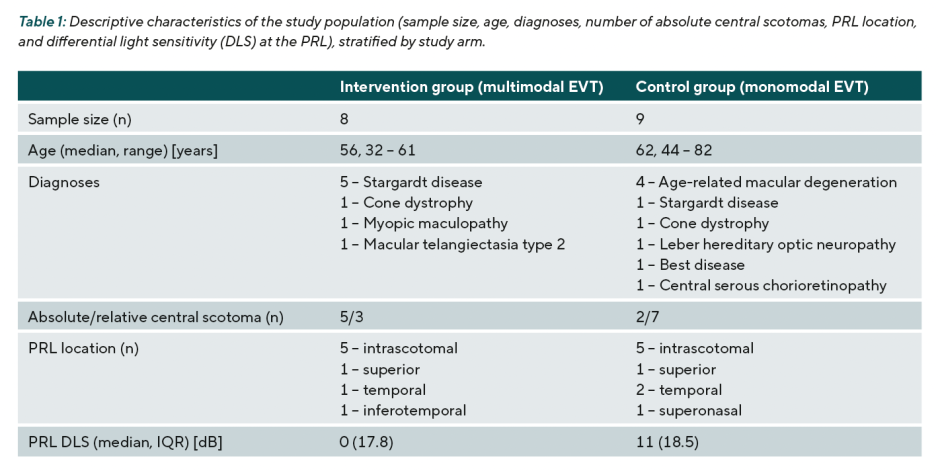
The analysis included 17 participants (intervention group: n = 8; control group: n = 9). One participant was excluded due to mirtazapine treatment initiated during rehabilitation and subjectively reported visual disturbances. Characteristics of the study groups, including age, diagnoses, and type of central scotoma, are presented in Table 1.
Assessment methods
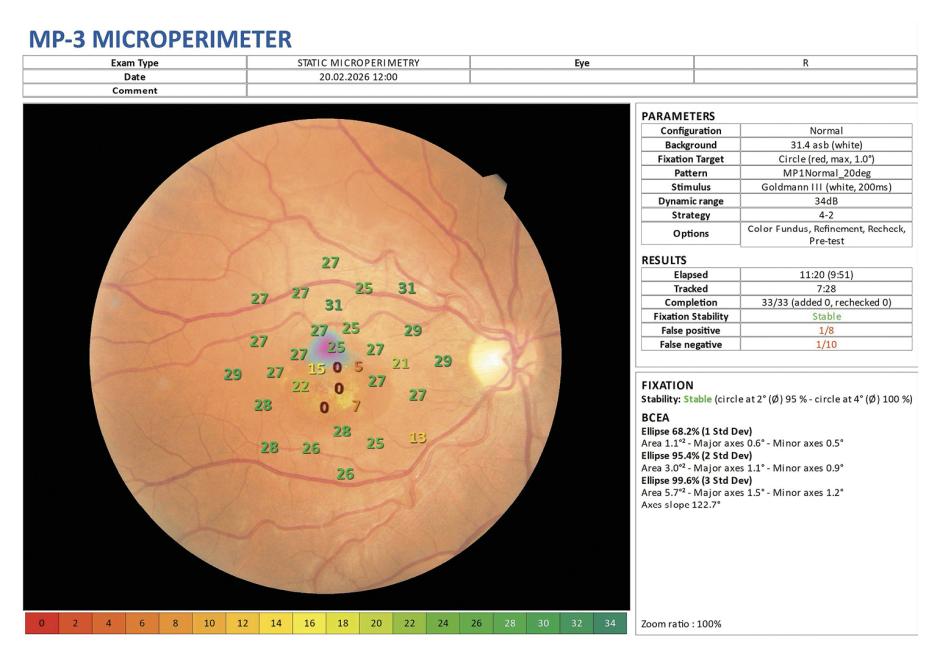
PRL and TRL characteristics were obtained using microperimetry (MP-3 microperimeter, NIDEK Co., Ltd., Gamagori, Japan; Figure 1). Retinal location, differential light sensitivity (DLS), and fixation stability were assessed. Fixation stability was quantified using P1, P2 as well as the bivariate contour ellipse area (BCEA). P1 and P2 indicate the percentage of fixation points located within a radius of 2° and 4°, respectively, around the PRL or TRL. The BCEA represents the area of an ellipse containing the fixation points with a defined probability.
Reading speed was assessed using the International Reading Speed Texts 16 (IReST; Precision Vision, Woodstock, IL, USA) and the Smith-Kettlewell Reading Test 17 (SKread; Precision Vision, Woodstock, IL, USA).
The IReST comprises ten continuous passages written at a sixth-grade reading level.16 The texts were presented in a sans-serif font (Arial) in two font sizes (9 pt and 18 pt), according to the method described by Rubin et al.18 Optical magnification aids were permitted.18
The SKread test was specifically developed for patients with (para-)central scotomas.17,19 It was additionally used to assess reading speed, which primarily depends on visual word and letter recognition, as well as the reading error rate. It is based on text passages containing randomly arranged individual letters and words without semantic relationships. This minimizes the influence of reading experience, vocabulary, and educational level on reading performance.
Further secondary parameters included BCVA (FrACT,20 version 3.1.2, Universitäts-Augenklinik Freiburg, Germany), contrast sensitivity (MARS test, Mars Perceptrix, Chappaqua, NY, USA), and reading acuity (Nahleseprobe 2, Oculus Optikgeräte GmbH, Wetzlar, Germany).
Subjective visual function and vision-related quality of life were evaluated using the Rasch-calibrated version of the National Eye Institute Visual Function Questionnaire (NEI VFQ-25-C21). The total score and the subscales “visual functioning” and “socioemotional functioning” were used. The questionnaire captures perceived limitations in daily activities resulting from visual impairment. Rasch calibration facilitates comparability across results.21
Usability and the subjective benefit of the training were assessed using a study-specific questionnaire comprising visual analogue scales and free-text fields.
Study procedure
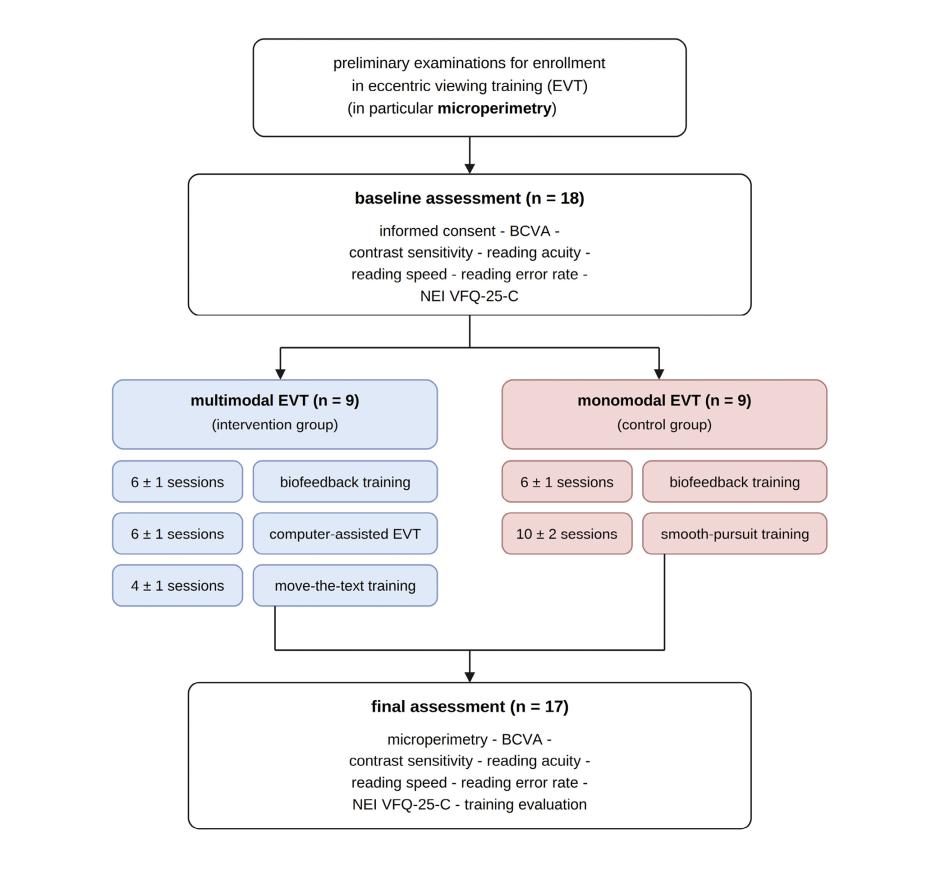
The study procedure is illustrated in Figure 2.
The intervention group received multimodal EVT consisting of microperimetric biofeedback training, computer-assisted EVT using DeZent software (version 2.0, SFZ Förderzentrum gGmbH, Chemnitz, Germany), and supervised and self-directed move-the-text training. The control group completed microperimetric biofeedback training (analogous to the intervention group), supplemented by supervised and self-directed smooth-pursuit training.
Biofeedback training was performed under standardized conditions in both study arms, monocularly using the functionally better eye. TRL positioning was preferentially established in the superior retinal hemifield, provided that sufficient differential light sensitivity was present.2,7 The retinal area defined for eccentric fixation at the TRL was initially set to a diameter of 3° and, where possible, reduced to 1.5° during subsequent training sessions. Training was conducted twice weekly in an interval format, with three fixation intervals of 60–90 seconds per session. Continuous real-time acoustic feedback provided participants with information on the position of their fixation relative to the target area of the defined TRL.
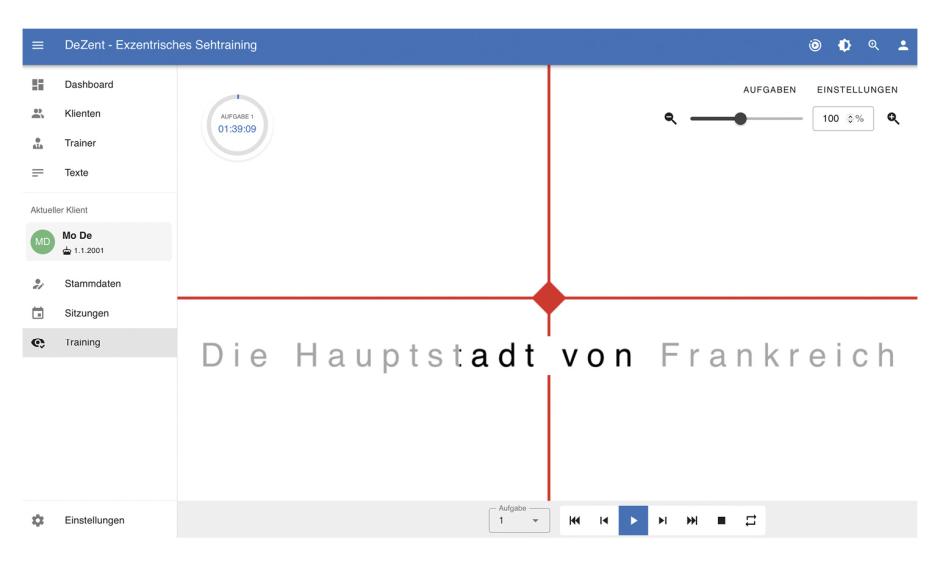
The computer-assisted EVT was conducted twice weekly in 45-minute sessions to facilitate the use of the TRL during reading. Figure 3 shows a screenshot of the DeZent program during a training task. Beginning in the second week, the training was supplemented by the move-the-text strategy. In this approach, printed texts were actively moved through the TRL area under eccentric fixation using individually adapted optical magnification aids (hyperoculars). Similar to the computer-assisted training, this resulted in a scrolling-text presentation and facilitated eccentric reading under everyday conditions.
The smooth-pursuit training in the control group involved following moving targets with smooth eye movements. The speed, direction, and complexity of the target trajectories were progressively increased.
The final assessment was performed after a three-week intervention period (±3 days).
Statistical analysis
All analyses were exploratory and were performed using IBM SPSS Statistics version 31.0.2.0 (IBM Corp., Armonk, NY, USA). Due to the small sample size, only nonparametric statistical methods were used. Between-group comparisons were performed using the Mann-Whitney U test, while within-group pre-post comparisons were performed using the Wilcoxon signed-rank test or the sign test, depending on the distribution of the differences. The significance level was set at α = 0.05, and all statistical tests were two-sided.
Results
TRL establishment
The median intervention duration was 19 days (IQR 6 days) in the intervention group and 20 days (IQR 6 days) in the control group. Participants in the intervention group completed a median of six biofeedback training sessions, six DeZent sessions, and four move-the-text sessions, while those in the control group completed a median of six biofeedback training sessions and eight smooth-pursuit training sessions.
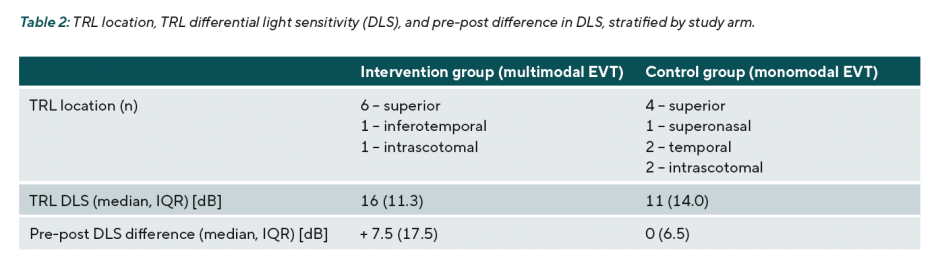
In both study arms, a TRL in a functionally favorable location could be established in the majority of participants, predominantly in the superior retinal hemifield. Further details on the distribution of TRL positions are provided in Table 2.
The median pre-post increase in DLS at the extrafoveal fixation location was significantly greater in the intervention group (+7.5 dB; IQR 17.5 dB) than in the control group (0 dB; IQR 6.5 dB; Mann-Whitney U test, p = 0.04).
Primary endpoint: Reading speed
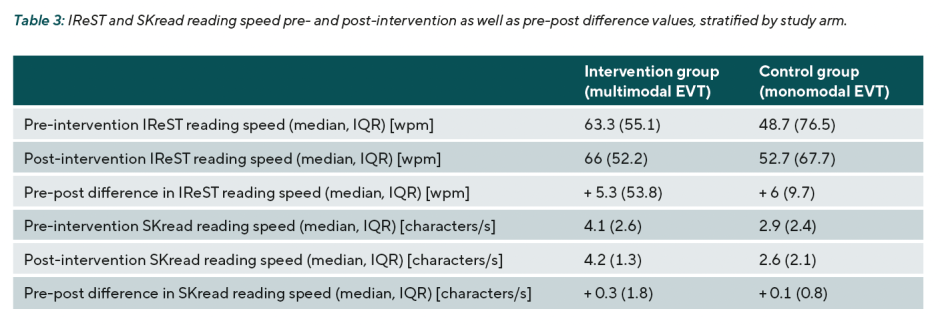
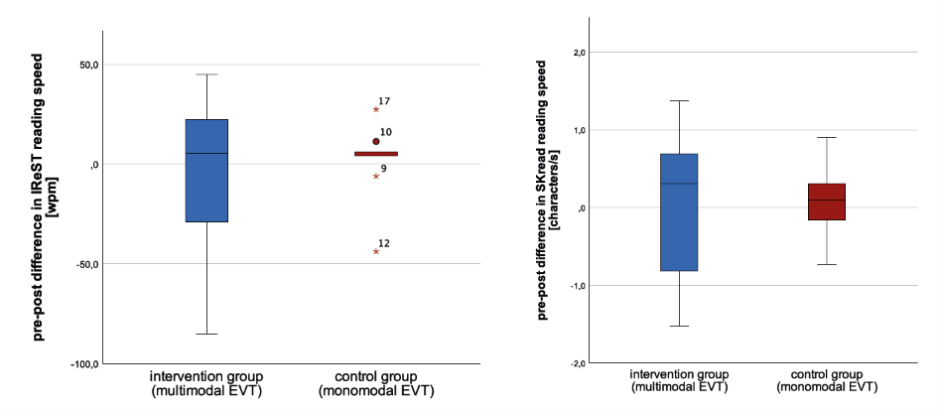
Neither the IReST nor the SKread showed significant between-group differences (IReST: Mann-Whitney U test, p > 0.99; SKread: Mann-Whitney U test, p = 0.74). Table 3 presents the pre- and post-intervention median reading speeds, while Figure 4 shows the distribution of pre-post changes. Reading speed measured with the IReST increased slightly in both study arms. The median increase was 5.3 wpm (IQR 53.8 wpm) in the intervention group and 6.0 wpm (IQR 9.7 wpm) in the control group, with no significant within-group pre-post changes (intervention group: sign test, p = 0.73; control group: sign test, p = 0.18). A clinically relevant increase of ≥ 12.9 wpm, corresponding to the coefficient of repeatability (CoR) for maculopathies,22 was achieved by three of the eight participants in the intervention group and one of the nine participants in the control group. The SKread results also showed no significant within-group changes in reading speed (intervention group: sign test, p = 0.73; control group: Wilcoxon signed-rank test, p = 0.60). The median pre-post difference was +0.3 characters/s (IQR 1.8 characters/s) and +0.1 characters/s (IQR 0.8 characters/s), respectively (Table 3). Changes in reading speed varied considerably between participants in the intervention group.
Fixation stability
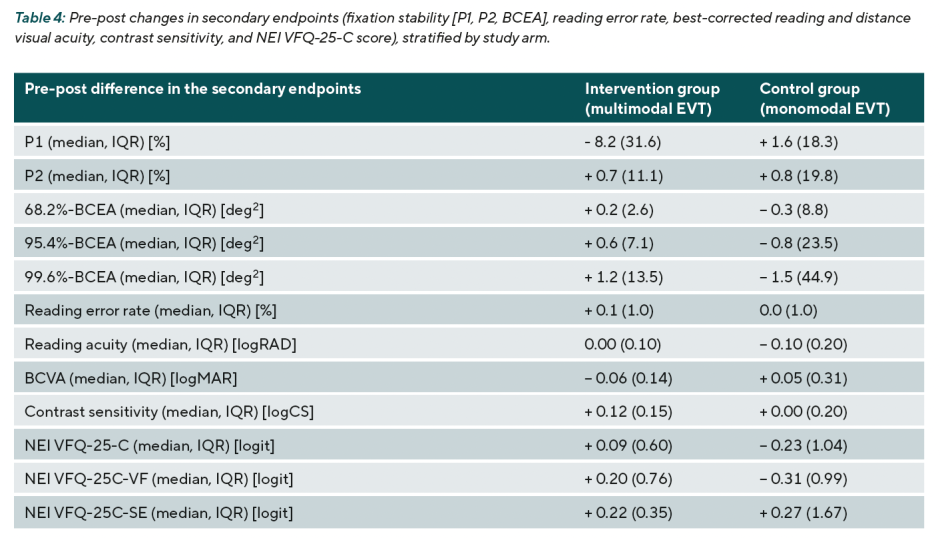
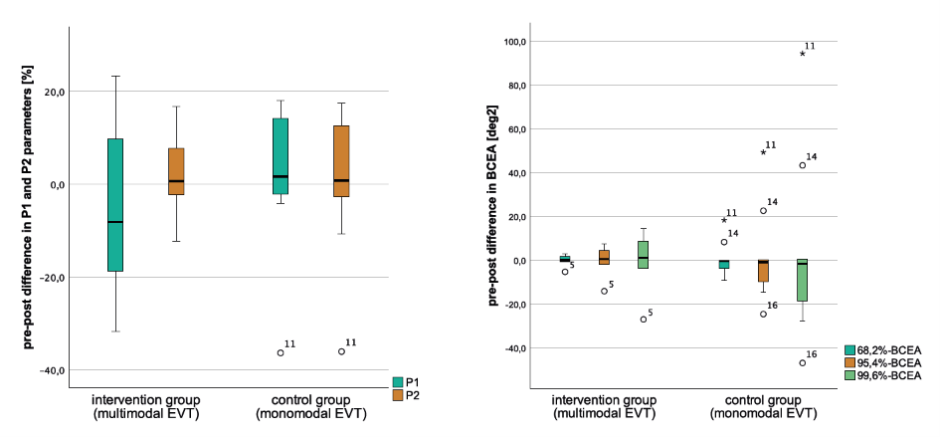
None of the assessed fixation stability parameters (P1, P2, BCEA) showed significant within-group pre-post changes or significant between-group differences in pre-post changes. The median difference values for the individual parameters are summarized in Table 4, and the distribution of pre-post changes is shown in Figure 5. Descriptively, the intervention group showed a tendency toward lower fixation stability, reflected by lower P1 values, largely unchanged P2 values, and predominantly positive interquartile ranges of the pre-post BCEA differences. In contrast, the control group showed a descriptive tendency toward higher fixation stability, with predominantly positive interquartile ranges of the P1 and P2 differences and negative interquartile ranges for BCEA.
Other visual function parameters
As summarized in Table 4, no significant median pre-post changes were found for reading error rate, reading acuity, BCVA, or contrast sensitivity. In the intervention group, BCVA and contrast sensitivity showed slight descriptive improvements. However, these changes were within the known test-retest variability of the respective methods.
Subjective parameters
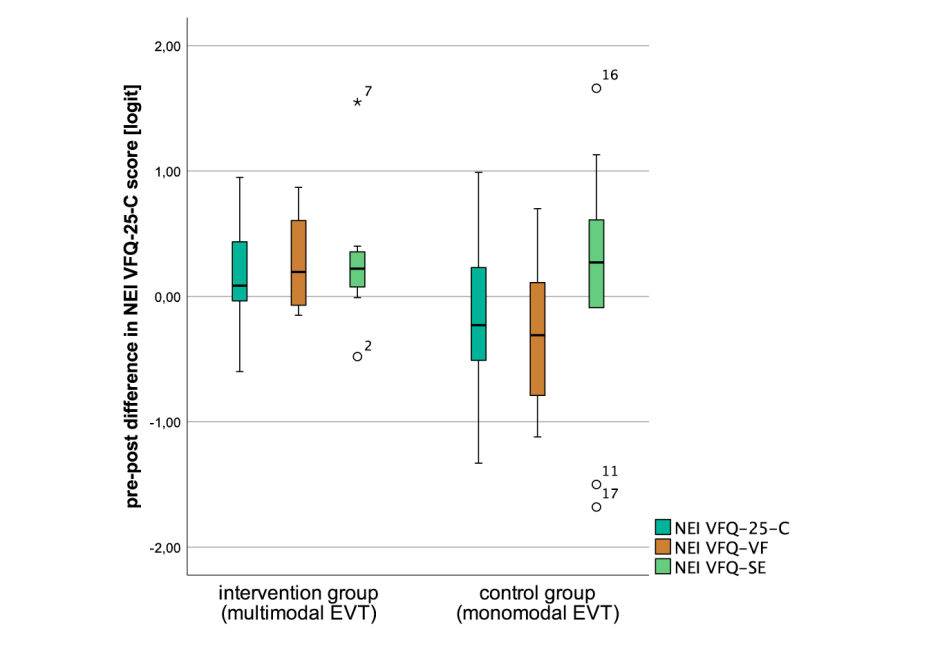
The NEI VFQ-25-C showed no significant changes in the total score or in the “visual functioning” and “socioemotional functioning” domains. Figure 6 illustrates the pre-post differences for the individual domains. In the intervention group, predominantly positive pre-post differences were observed. In contrast, the control group showed heterogeneous changes, with a tendency toward positive differences in the socioemotional domain and small, primarily negative differences in the total score and the “visual functioning” domain.
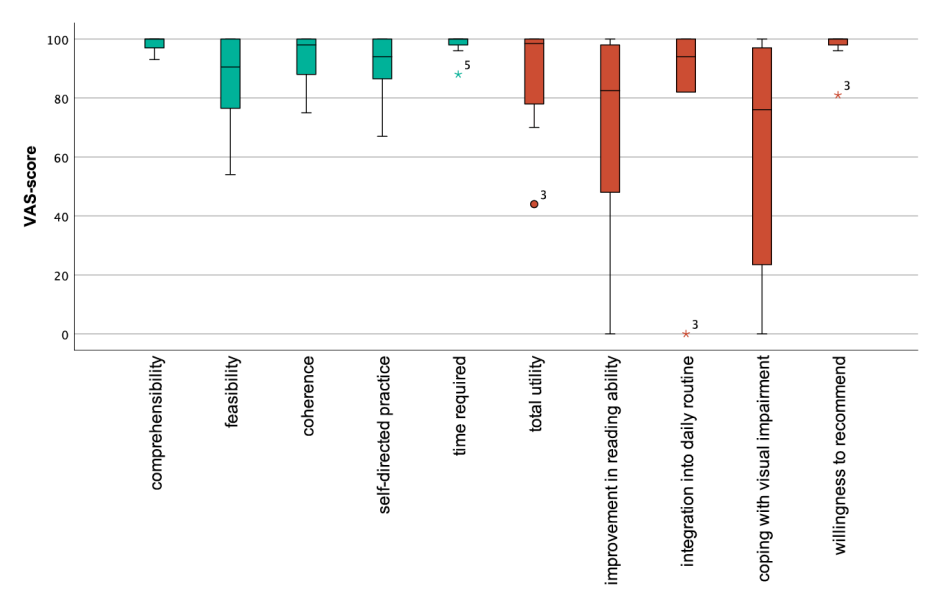
The results of the usability assessment of the multimodal EVT are shown in Figure 7. Overall, the multimodal EVT was rated very positively. Median scores on the visual analogue scales consistently exceeded 90 points, with greater interindividual variability in the ratings of the ability to perform the exercises and the integration of the training into routine rehabilitation. The perceived benefit varied considerably between participants, particularly with regard to reading ability and coping with visual impairment. The training received a median recommendation score of 100 points. Qualitative feedback particularly highlighted the reading-related training modules DeZent (2 mentions) and move-the-text (4 mentions), whereas biofeedback training received both positive (2 mentions) and negative (3 mentions) ratings.
Discussion
The multimodal EVT did not show a significant advantage over the monomodal approach in terms of reading speed or other objective functional parameters. This finding should be interpreted in the context of the short intervention period, the heterogeneous baseline retinal characteristics, and methodological limitations.
The study was conducted within an inpatient, multiprofessional rehabilitation setting. Consequently, the intervention period was limited to three weeks, placing it at the lower end of the training durations reported in the literature.9,12,13 At the same time, participants received additional therapeutic interventions, resulting in increased treatment demands compared with those in studies investigating isolated training interventions. Organizational interruptions and varying intervals between training sessions may have further influenced adaptive processes.
The two study arms also differed with respect to their baseline retinal characteristics. In the intervention group, PRLs were predominantly located within absolute central scotomas, so that relocation of the fixation locus was initially required, whereas in the control group the focus was on consolidating already-established eccentric fixation strategies. The between-group comparison is therefore only of limited interpretability, since the two study arms addressed functionally different training objectives.
The establishment and consolidation of a TRL represent a multistage adaptive process, with complete oculomotor integration potentially requiring several months.4,23 The three-week observation period therefore probably captures predominantly early sensorimotor adaptations. This may also explain the tendency toward a transient decrease in fixation stability observed in the intervention group, which may reflect ongoing TRL reorganization. Accordingly, functional improvements in reading ability are expected to occur following further consolidation of the eccentric fixation strategy.
The differing age and diagnosis distributions between the study arms, as shown in Table 1, should be considered potential confounders in this context. The intervention group predominantly included younger participants with hereditary macular dystrophies, whereas the control group mainly comprised older individuals with degenerative or vascular maculopathies. Reports on the influence of age on neuroplastic reorganization processes are inconsistent in the literature, and this influence should be interpreted in the context of diagnosis, disease duration, and pre-existing adaptive processes.6,24
Furthermore, baseline reading speed was higher in the intervention group than in the control group, so a ceiling effect cannot be ruled out. An inverse relationship between baseline performance and training-related gain has been documented in the literature.24
The pronounced interindividual variability in reading speed changes is consistent with a responder/non-responder pattern. Comparable differences have previously been associated with baseline retinal characteristics, fixation stability, baseline reading speed, as well as cognitive and motivational factors.24,25
A further possible explanation relates to the demands of eccentric reading. Crowding effects and a reduced perceptual span are considered major limiting factors for reading speed during eccentric fixation.6,26 In addition, the optical magnification required reduces the effective field of view available for reading. The training methods used primarily target the establishment of a functional TRL and the stabilization of eccentric fixation. However, increasing reading speed requires further perceptual and cognitive adaptation, which may develop spontaneously during the ongoing adaptation process but can also be promoted by specific training formats, such as perceptual learning or RSVP training.26
The dosage of biofeedback training should also be considered when interpreting these findings. With a median of six sessions and an effective exposure time of three to four-and-a-half minutes per session, the training dose was lower than that reported in comparable studies, which typically comprised ten to fifteen sessions with an exposure time of approximately ten minutes and, in some cases, daily interventions.12,13,25,27 However, the reduced dose should be viewed in the context of the multimodal rehabilitation concept and the need to manage overall treatment load. Both study arms used exclusively acoustic biofeedback, which is supported by a broad evidence base and high acceptance. Comparative studies, however, indicate a higher efficacy of light-stimulus biofeedback compared with acoustic biofeedback, although its use should be evaluated individually with regard to tolerability.11,12,25
In addition, methodological limitations of microperimetry may restrict the informative value of the fixation stability parameters. Fixation instability, central lesions, and a limited view of the fundus complicate reliable eye-tracking-based characterization and localization of the PRL and TRL. Furthermore, luminance-dependent shifts in PRL/TRL location,28 the dynamic measurement methodology, and fatigue effects may impair the reliability and validity of the measurements.
With regard to the NEI VFQ-25-C, it should be noted that this instrument captures short-term rehabilitation effects only to a limited extent and primarily assesses domains of function that are relevant to daily life and stabilize over the longer term.29 Moreover, multiprofessional rehabilitation can produce positive psychosocial effects independently of objectively measurable functional gains,29,30 which is reflected in the tendency toward an increase in the socioemotional domain observed in both groups. The more favorable tendency observed in the intervention group in changes of the NEI VFQ total score and the “visual functioning” domain may be attributable to the fact that the multimodal EVT included reading-related modules, thereby enabling renewed engagement with everyday reading situations. At the same time, multiprofessional rehabilitation may lead to a more critical self-perception of functional limitations,30 which could explain the negative change in the visual functioning domain observed in the control group.
The discrepancy between the high level of subjective satisfaction and the absence of significant changes in objective functional parameters is consistent with previous observations from low-vision rehabilitation. According to these observations, subjective ratings are substantially influenced by psychosocial factors, the therapeutic interaction, and active engagement with the visual impairment.24,30
In the qualitative evaluation of the training, the reading-related components (DeZent and move-the-text) were rated particularly positively, whereas biofeedback training was evaluated more controversially. This may plausibly be explained by the greater everyday relevance of the reading-related training modules compared with the clinical
fixation-stability training.
As suggestions for improvement, participants most frequently mentioned an earlier start of training after admission to rehabilitation and a structured, low-barrier follow-up program, reflecting the high value they placed on the training.
These results should be interpreted with caution owing to the small sample size, the short observation period, the lack of long-term follow-up, the heterogeneous baseline retinal characteristics, and the absence of an untreated control group. Overall, the present findings should be regarded as hypothesis-generating.
Conclusion
In the present study, no significant benefit of multimodal eccentric viewing training was observed compared with a monomodal approach during the three-week inpatient intervention period. The findings suggest that the observed changes predominantly reflect early adaptive processes and that longer follow-up periods are required to assess the functional benefit.
Nevertheless, the successful establishment of a TRL and the high acceptance and positive evaluation of the reading-related modules support the practical relevance of the multimodal concept for rehabilitation, even though its effectiveness within the present intervention framework was constrained by temporal and structural conditions. For further optimization, greater modular individualization based on the microperimetrically determined PRL configuration appears particularly promising. Whereas the establishment of a functional TRL through biofeedback training should take priority in patients with an intrascotomal PRL, reading-specific training modules could be prioritized in those who already have functionally favorable eccentric fixation. Optimized biofeedback parameters, as well as an intensification of training through an extension of rehabilitation to up to six weeks, represent potential approaches for promoting further adaptive processes. In addition, structured, low-barrier follow-up and home-training programs could help stabilize eccentric fixation strategies over the long term.
Conflict of Interest
The authors declare that they have no financial conflicts of interest. Lea Holland-Moritz, Prof. Dr. habil. Kathleen Kunert, and Dr. Oliver Kolbe are affiliated with Henneberg-Rehaklinik Masserberg GmbH.